Soro has a very appealing pitch if you have ever been responsible for keeping a website’s blog alive. Connect your site, let the software work out what to write about, and new SEO articles begin appearing without anyone having to research keywords, commission a writer, prepare briefs, source images, add internal links or remember to hit publish.
For a small publisher or business owner, it is easy to see why that sounds attractive. The starting price is a fraction of what you would normally pay an SEO agency or freelance writer, and the software promises to take over much of the repetitive work that makes content marketing difficult to sustain.
We wanted to see how far that promise holds up in practice, so we connected Soro to The Big Bag Blog, an established handbag publication, and let it publish throughout the period from 16 September to 15 October 2026. We then reviewed what it had written, compared the new articles with content already on the site, and looked at the site’s Google Search Console performance over the same period.
After a month, we think Soro may be useful, but it is also much easier to see where the limits of “automated SEO” begin. The short version is that Soro can take over a surprising amount of content production. However, we would not, based on this test, treat it as a replacement for SEO strategy.
About this review
We tested Soro on The Big Bag Blog for roughly one month, from 16 September to 15 October 2026, to see how much of the SEO process an automated service could realistically take over. Rather than judging it only on the articles it produced, we also looked at Google Search Console data, compared the new posts with existing content on the site, and checked whether the publishing activity was translating into meaningful search visibility.
This is not a long-term ranking study, and one month is too short to judge the full SEO potential of newly published pages. What it does give us is a useful first look at where Soro is genuinely helpful, where the automation starts to show, and which parts of SEO still benefit from human judgement.
Key takeaways
- Soro is good at keeping content production moving. It consistently found relevant long-tail topics, drafted articles, handled formatting and publishing, and removed a large amount of repetitive work.
- We did not see a measurable SEO traffic lift during the first month. The Big Bag Blog recorded 58 Google Search impressions and no clicks during the test period, so there is not yet enough evidence to say the new content improved organic traffic.
- The topic ideas were generally sensible, but not always strategically necessary. Some new articles overlapped with older pages that were already receiving impressions, which raises the question of whether those topics needed new URLs or whether the existing content should have been improved instead.
- The writing becomes recognisably automated when you read several posts together. Individual articles were generally competent, but repeated structures, phrases and editorial habits became much more obvious across the wider content library.
- Soro can replace a substantial part of SEO content production, but not the strategic layer. It can help with research, drafting, formatting, internal linking and publishing. It is much less suited to deciding when to consolidate pages, which existing URLs deserve attention, where technical or authority problems are limiting growth, or whether another article should be published at all.
- Its strongest use case is probably as a production tool with human oversight. For a small business or publisher that struggles to maintain a content schedule, the efficiency can be very useful. We would still review the content plan, check for overlap with existing pages and use Search Console data to decide what happens next.
Our main takeaway after the first month is that tools like Soro are making the mechanical parts of SEO much cheaper. That does not make SEO strategy obsolete. If anything, it makes the quality of the decisions around what to publish, update, merge or leave alone more important.
What Soro actually produced

The first thing it did well was something that sounds simple but is often the hardest part of running a content site: it kept publishing.
Over the month, Soro produced articles around Hermès quota bags and prespend, Kelly sizes, Chanel Classic Flap sizes, Birkin leathers, handbag storage, vintage Chanel dating, bag glazing, resale value, Louis Vuitton date codes, Bottega Veneta intrecciato, authentication and leather repair.

Most of those topics make sense for The Big Bag Blog. They are specific enough to reflect real search questions, and they sit close to the site’s existing subject matter rather than wandering into loosely related lifestyle topics simply because the keywords are easier.
One of our concerns going into the test was that automated topic selection would produce a queue full of generic luxury-fashion articles that technically contained relevant keywords but had very little reason to exist.
Thankfully, the output was better than that. A query around Kelly sizes has an obvious practical intent. Someone researching bag glazing is probably worried about wear or repairs. A person searching for Louis Vuitton date codes may be evaluating a pre-owned bag. These are all questions where a useful article can sit naturally within the publication.
From a production point of view, this is where Soro makes the strongest case for itself. If the alternative is a blog that has gone untouched for six months because nobody has time to write, having the research, drafting, formatting and publishing handled automatically is a meaningful improvement.
The Search Console result after one month
Where we need to be much more cautious is in calling that continuous publishing an SEO result.
The Search Console export for 16 September to 15 October showed 58 Google Search impressions and no clicks across The Big Bag Blog during the period. The impression-weighted average position was roughly 49.
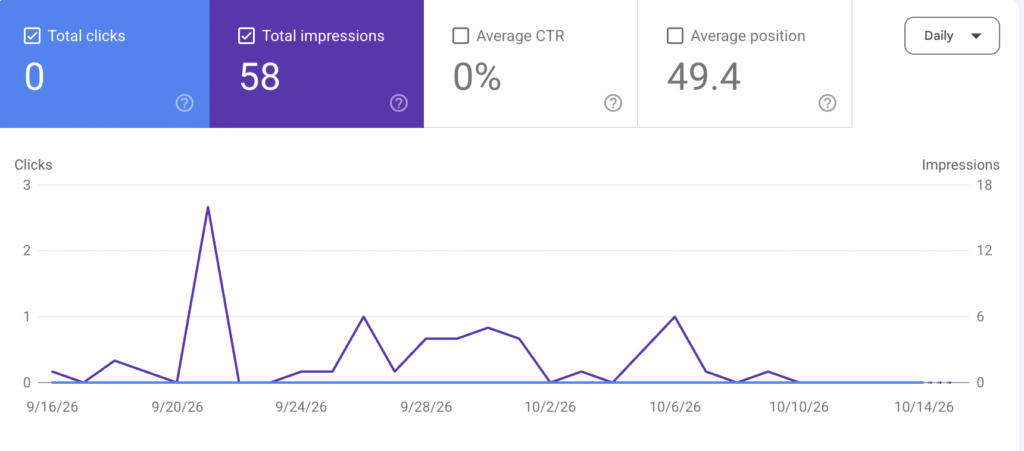
There was no obvious upward curve towards the end of the month either. The site recorded 42 impressions before 1 October and another 16 from 1 October onwards. That is clearly not the sort of result anyone would use in a sales deck to demonstrate an SEO win.
Of course, any SEO professional worth their salt would know better than to say that the articles have failed. Several of the Soro posts had only been live for a matter of days or weeks when the reporting period ended, and a post published on 15 October obviously cannot be judged meaningfully using data ending on the same day. Search performance tends to develop much more slowly than the publishing process itself.
What we can confidently say then, is that a month of frequent publishing did not immediately translate into a noticeable increase in organic search traffic. That is useful because SEO automation products make it incredibly easy to see activity. New URLs appear every few days. The blog looks busy. The content library grows. None of those things necessarily means Google is rewarding the work yet.
The new pages are being discovered and crawled, which tells us the publishing setup itself is working. But crawling, indexing, earning impressions, ranking and earning clicks are separate stages, and most of the Soro-era posts had not reached the latter stages during this test.
In fact, the pages showing the strongest positions in the Search Console data were mainly older articles. Existing pages on topics such as Lady Dior, vintage Chanel and Hermès leathers were already appearing in reasonably strong positions despite the very small overall impression volume. That became more interesting once we started comparing them with the new content.
Where automation starts to make things messy
Individually, many of the Soro articles are perfectly competent. Read one in isolation and there is often little to object to. The structure is clear, the topic is covered thoroughly enough and the writing is serviceable. However, read a dozen of them together and the automation becomes easier to spot.
The articles tend to follow a similar rhythm: open with a buyer’s dilemma, explain why the obvious answer is more complicated than it looks, work through practical considerations, and finish with a measured conclusion about choosing the bag that suits your life rather than following hype.
Soro also picked up one of The Big Bag Blog’s editorial lines, “for people who care about the bag, not just the logo,” and proceeded to use versions of it repeatedly.
The first time, it sounds like brand voice. After it starts appearing across articles about glazing, resale value, Chanel sizing, Hermès and authentication, it feels more like a prompt instruction that has been learned too literally.
There are similar recurring phrases and rhetorical devices across the newer posts, which make the publication feel more templated.
This is the sort of thing an editor notices by reading across a site rather than judging each article as a standalone deliverable. It is also relatively easy to fix if someone is reviewing the work. Left completely unattended, however, the repetition accumulates.
The more important problem is not the writing
The biggest limitation we found was more strategic: Soro can identify a sensible keyword and turn it into an article, but what it does not always appear to do is ask whether the site already has a page that should own that topic.
For example, Soro published a new article explaining Hermès prespend during the test period. The Big Bag Blog already had an older guide covering Hermès prespend and quota bags, and that existing page was already generating Search Console impressions.
The same issue appeared around Hermès leather. Soro produced a new Birkin leather comparison while an established Hermès Leather Guide was already appearing in Search at an average position of roughly 3.5.
That does not automatically make either new article a mistake. There is room for a broad Hermès leather guide and a more specific Birkin comparison if the two pages serve clearly different searches, but that distinction needs to be deliberate. Before creating the second page, we would want to know what the existing article ranks for, where it is weak, whether the newer article genuinely serves a different intent, which page should own broader terms, and how the two should link to each other.
Sometimes the correct SEO decision is to publish nothing
This test also reminded us of something that becomes easy to forget when content production suddenly becomes very cheap: more content is not automatically the thing a website needs most.
Looking at The Big Bag Blog’s Search Console data, our first instinct would not be to conclude that the site simply needs another 30 posts next month.
There are existing pages already appearing in strong average positions but receiving very few impressions. There are older pieces that overlap with newer Soro topics. There are also probably opportunities to strengthen internal linking, consolidate related articles, improve titles, update existing guides and decide which topics genuinely warrant their own URL. Those decisions are harder to automate because they involve the site as a whole.
Content software is naturally biased towards production because that is what it is designed to do. If it can reliably generate another article tomorrow, the obvious next action is to generate another article tomorrow.
However, a human SEO strategist has the option of saying that tomorrow’s best SEO task is not an article at all. It might be rewriting a title that is getting impressions but no clicks, merging two pages that are competing with one another, improving a category structure, fixing an indexing issue, strengthening an important commercial page or simply leaving a topic alone because the demand is not worth chasing. That judgment is a large part of what people should actually be paying an SEO agency for.
Could Soro replace a content writer?
For some businesses, we think it could replace a significant portion of that work.
The economics are difficult to ignore. If you mainly need straightforward informational articles in a niche where factual risk is relatively low, Soro can handle much of the process that would traditionally involve an SEO, a writer and someone uploading the content into WordPress. It researches topics, creates drafts, formats articles, handles basic internal linking and publishes consistently. For a founder who has spent months telling themselves they really need to get the blog going again, that may be more useful than a sophisticated content strategy that never gets implemented.
The quality of automated blog publishing is also considerably better than the old generation of autoblogging tools that produced barely readable pages around any keyword they could find.
Unfortunately, we still need a human reviewing the output. Part of that is factual checking, particularly for topics where incorrect information matters. But much of it is editorial. Does this article repeat something we published six months ago? Does the introduction sound exactly like the last four posts? Has a brand phrase been used so often that it has stopped sounding like a brand phrase? Is this genuinely the best new page for the site to publish?
Could it replace an SEO agency?
The answer depends heavily on what you think an SEO agency is supposed to do.
If the agency’s monthly retainer consists mostly of finding keywords and delivering four blog articles, then software like Soro is absolutely a threat to that model. It is becoming increasingly difficult to justify large fees for work that can now be produced quickly and cheaply.
But we should expect a good SEO engagement to go much further. An agency should be looking at which pages Google has indexed and which it has ignored, how the site is structured, where existing rankings are close to improving, whether several pages are competing for the same searches, whether important money pages are strong enough, whether content is converting visitors into anything useful, where links and external authority matter, and whether the website should be publishing more in the first place.
It should also be able to look at something like The Big Bag Blog’s first month with Soro and resist the easy conclusion. Yes, the site published consistently, but the Search Console data showed 58 impressions and no clicks. That part has not worked yet.
A useful SEO response is not simply “publish more until it does”. We would want to understand why the overall search footprint remains so small, why some existing pages can sit around positions three or four and still receive so little demand, whether newer pages are adding useful coverage or dividing it, and what else is limiting the site’s visibility.
Our verdict after the first month
We are going to keep watching the Soro content rather than judge it entirely on 30 days of Search Console data. That seems the fairest way to review an SEO product. We know that several of the posts have simply not existed long enough to tell us much, and some may gain visibility over the next few months.
There is already enough evidence, however, to form an opinion about the product itself. Soro is good at getting work done, where the topics it selected were generally sensible, the articles were competent enough to publish, and it took a large amount of repetitive content work off the table.
Where we would be more careful is the idea of “SEO autopilot”. A site with an existing archive needs someone looking across the whole thing. New topics need to be checked against old ones. Search Console needs to influence what happens next. Repetitive writing needs editing. Pages that are already close to ranking deserve attention. Sometimes a new article is the answer, and sometimes it is precisely the thing you should not create.
That is why our first month with Soro has not convinced us that SEO agencies are becoming unnecessary. If anything, it has convinced us that some of the work agencies have historically charged for is becoming commoditised.
Producing a competent 1,500-word SEO article is no longer particularly difficult or expensive. Researching straightforward keywords is increasingly automated. Uploading a post, adding internal links and scheduling content should not account for a large portion of a modern SEO retainer. The harder part is deciding where the website should go next.
For now, that is still where we see the difference between an automated SEO service and an SEO agency worth paying for. Soro can keep the publishing machine moving, but any sensible business owner should still want someone deciding whether the machine is moving in the right direction.